

Fact-Check Friday: All-or-Nothing Thinking
I guess this is my life now.

Pre-reading catchup:

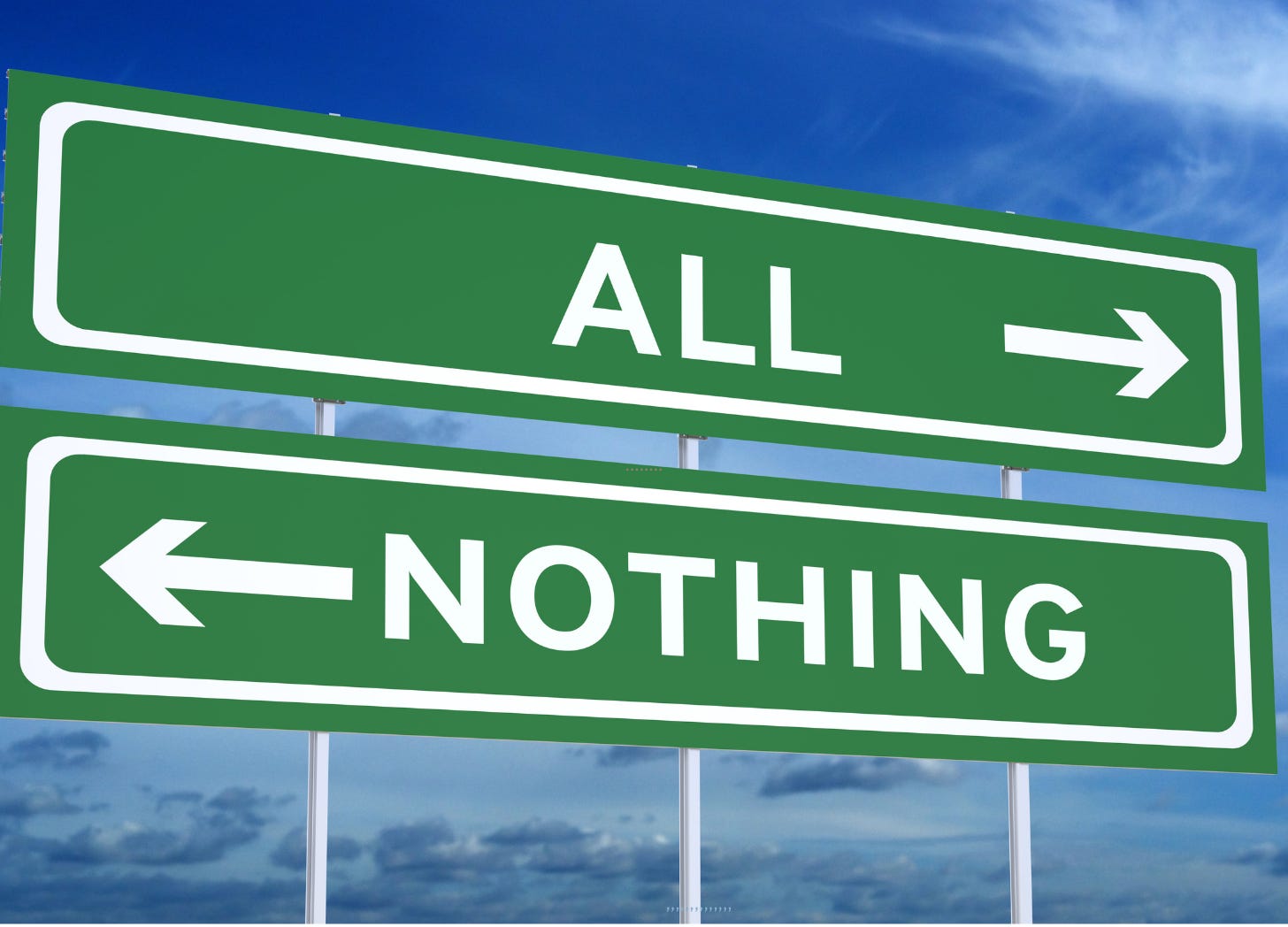
One of the most common cognitive distortions is all-or-nothing thinking—the belief that things are either entirely good or entirely bad, success or failure, worthy or worthless. It’s the mental habit of seeing life in extremes, without room for nuance, complexity, or growth.
It sounds like:
“This is my life now.” This is a resignation to a perceived permanent state, often after a setback. This is my personal favorite.
“I blew it.” This implies total failure from a single mistake.
“I’m either all in or I’m out.” This suggests that anything less than full commitment is worthless.
“I’ll never get it right.” This dismisses progress because of imperfection. It is particularly problematic messaging for people in recovery.
“What’s the point?” This is when we abandon effort when perfection isn’t possible.
“I have to start over.” This is ignoring partial progress because it doesn’t meet an ideal.
These phrases reflect the emotional tone of all-or-nothing thinking: rigid, absolute, and often self-defeating. They’re especially common in contexts like dieting, recovery, productivity, relationships, and finances—any area where scarcity and perfectionism collide. They’re also especially common in everyday parlance. I hear them all the time.
This particular cognitive distortion doesn’t just affect our self-talk. It can quietly sabotage our ability to take risks, recover from setbacks, or recognize progress. When we’re stuck in all-or-nothing thinking, we tend to abandon efforts prematurely, avoid vulnerability, and judge ourselves harshly for being human.
