Issue 84: Terminology Tuesday: Intergenerational Transmission
Nature, nurture, and the nervous system.


In This Issue
Recent Issues
Terminology Tuesday: Intergenerational Transmission
Food for Thought: The Neurobiology of Friendship
Updates:
New on the Marsh Press Etsy Store
Fat & Drunk Entries
Recent Issues
Fact-Check Friday: Memory is Not a Moral Issue
In this issue, a revealing text exchange with friends about the day I quit drinking recently reminded me that the human brain evolved to constantly reconstruct the past, not to keep a flawless objective archive. Instead of feeling shame over our forgotten details, we can lean into the neurobiology of memory reconsolidation to stay curious, physically remap our neural pathways, and allow the people we love to help expand our stories.
Terminology Tuesday: Attribution and Scapegoating the World Cup Loss
In this issue, Terminology Tuesday looks at the USMNT's World Cup loss through the lens of Attribution Theory and scapegoating, exploring how the president's interference created an ethical cloud that may have genuinely rattled the team's psychology. It connects this to how neural pathways prioritize familiar, fast explanations over accuracy whenever uncertainty feels threatening.

Terminology Tuesday: Intergenerational Transmission
The other day, I watched my dad make himself a bagel. I noticed he was using a block of cream cheese instead of the soft tub we keep in the refrigerator specifically for him. Immediately, I could see some family hocus pocus going on, so I checked it with him to be sure. While smiling with my voice, I lightly asked if he was using the block because he thought it was cheaper and therefore the one he should use.
He looked up, eyes crinkled, and said in the same smiling voice like he’d just been caught with his hand in the cookie jar, “Yes.”
Then I said, “I KNEW IT” like it was a eureka moment…and then I told him that he was eating the dog’s pill-hiding cheese. I reminded him that we buy the soft stuff because he likes it, and we can easily afford it. We both laughed, but the exchange lingered in my mind because I knew him on a cellular level, I swear.
His brain saw two versions of the same thing and instinctively reached for the one that felt less expensive, less indulgent, and more worthy of being used up. I recognized where his mind went because I have fought for years to deal with my similar impulses that I inherited from him—often overcorrecting and buying the most expensive and indulgent item to combat the profound sense of scarcity this type of thinking created in me. The cream cheese was purchased to be eaten, and replacing it would not create financial ruin, but deeply ingrained beliefs do not feel like beliefs. They feel like undeniable facts, which brings us to this week’s term.
What is Intergenerational Transmission?
While I was being molded and formed by my parents in the 1980s and 1990s, so was the term “family scripts,” a concept coined by psychiatrist John Byng-Hall to describe the unwritten behavioral rules we absorb from our caregivers. He compared family life to actors in a play, where we learn our roles by observing what causes stress, what earns approval, and what gets repeated until those observations become automatic assumptions about how the entire world operates.
Today, psychologists and neuroscientists refer to this as intergenerational transmission—the way coping strategies, worldviews, and emotional responses move seamlessly from one generation to the next. My parents never formally lectured me about using the cheaper option or preserving expensive things, yet those messages seamlessly found their way into my daily habits. We absorb these generational pathways long before we have the cognitive maturity to examine them. Hence, therapy for everybody. Just kidding. Not really. Maybe.
Replicative, Corrective, and Improvised Patterns
When we inherit these generational pathways, we typically respond in one of three ways. The first is strong transmission, or what Byng-Hall called a replicative script, where we unconsciously repeat the exact patterns and rules of our parents—like reaching for the block cream cheese to save a few pennies.
The second is an intergenerational contrast pattern, or a corrective script, which occurs when we consciously try to do the exact opposite of what our parents did to avoid their uncomfortable patterns. This is the path I often found myself following when I would buy the most expensive, indulgent item in the store just to combat the inherited feeling of scarcity. Unfortunately, it’s also the path I chose for almost everything, it seems, thanks to what my mother referred to as how “rule governed” my dad and his family were. (She was, too for the record.)
The problem with both repeating and contrasting is that neither provides true freedom; both are still ultimately controlled by the past. That leads us to the third type: improvisation, which happens when we create a healthy, flexible new path based on what works for us in the present moment. It’s the gray instead of the black or white.
Introjection Versus Social Learning
When we talk about absorbing these generational messages, it is helpful to distinguish between two different psychological frameworks: introjection and social learning. I talked about introjection when I was processing the memories that surfaced about a former workplace. It’s where we unconsciously swallow another person’s specific traits, attitudes, or exact voice whole. It is why we might suddenly hear a hyper-critical parent’s exact voice scolding us in our heads when we make a mistake.
Intergenerational transmission, however, aligns much more closely with psychologist Albert Bandura’s Social Learning Theory. This framework suggests that we acquire new behaviors and establish our baseline normal simply by observing how the people around us navigate the world. Unlike introjection, we are not necessarily internalizing our caregiver’s specific voice to manage anxiety; rather, we are quietly watching them save the good china for twenty years and independently absorbing the conclusion that nice things are not meant for everyday use. Because we learn through observation, these inherited patterns feel strangely automatic. They dictate our mannerisms, emotional habits, and knee-jerk reactions, wiring our nervous systems through decades of repetition.
The Invisible Rules that Run Our Lives
Most inherited patterns fall into a few broad categories that dictate our daily choices, often surviving long after the circumstances that created them disappear. The pathways were mapped. And they stay that way until they get remapped.
Money patterns, for instance, convince us to save the good stuff for a better occasion, always choose the cheapest option available, and assume financial struggle is completely normal even after we achieve stability. Similarly, work patterns equate our worth with productivity. These entrenched beliefs teach us that hard work is everything, rest must be earned, and saying no to extra work is inherently selfish—making relaxation feel incredibly uncomfortable even when rest is exactly what our nervous systems need.
These inherited beliefs also directly influence our personal boundaries and emotional lives. Relationship patterns insist that family comes before absolutely everything else, demanding that we handle problems alone, keep the peace, and ensure other people’s needs always come first. Meanwhile, emotional patterns establish rigid rules regarding the processing of feelings. People who grow up with these rules often struggle to distinguish between having an emotion and inappropriately expressing it, bound by various hidden beliefs. See also: eating disorders, substance use disorders, anxiety disorders, toxic masculinity, and so on.
Corticolimbic Circuitry And Generational Trauma
Many of these patterns originate as necessary adaptations to difficult circumstances like poverty, illness, or chronic stress. In response to trauma, families develop survival strategies that eventually become hardwired into their culture. However, modern neuroscience shows us that intergenerational transmission is not solely behavioral—it is deeply biological. I’m adding this to my knowledge about Adverse Childhood Experiences and the Intersectional Nature of Adverse Childhood Experiences as what can make us vulnerable to maladaptive coping later in life. We’ll talk about that on a future Terminology Tuesday, but it’s worth mentioning now.
This is where I am going to lean on the exact wording from the professionals, since I am a writer, not a researcher or clinician. According to a recent study published in JAMA Pediatrics, researchers found that parenting behaviors “are associated with brain architecture during adolescence,” physically shaping a child’s developing neural networks. Furthermore, a 2026 paper published in Frontiers in Psychiatry explains that through the mechanisms of environmental epigenetics, “trauma can contribute to lasting psychological, behavioral, and physiological effects that extend across generations.” While severe adversity does not change our actual DNA sequence, researchers note that it alters genetic expression, meaning our nervous systems might be biologically primed for high alert and scarcity before we even have the cognitive awareness to observe our parents’ behaviors. Let me stress that “before” again.
Where I’m more likely to think of other people and demographic groups experiencing such adversity more than my white middle-class family, I forget that there’s a whole generation that experienced great turmoil across the country, something that still affects us today.
My dad had a very close relationship with his own parents, meaning he spent his childhood soaking in their post-Depression scarcity wiring. Later in life, my grandfather lived large and owned a golf cart, but I am pretty sure my grandmother kept austerity at the fore. Dad got all of that. When money was genuinely scarce for our grandparents, saving everything was a practical necessity. For my parents, scarcity was real—at times—and also somewhat imagined or, simply, inherited.
The primary challenge is that this survival strategy—and the literal nervous system wiring that accompanies it—can easily outlive the danger that originally created it. Over time, a biological and behavioral adaptation morphs into a rigid family rule, and we learn that the world is unsafe simply by inheriting years of hesitation, anxiety, and self-denial. Especially if the Heaven’s Reward Fallacy is involved, which is another of my beefs.
Identifying And Rewiring Our Synapses
The easiest place to start identifying our own inherited patterns is by looking for reactions that seem disproportionately large for the situation, because the emotional weight usually points straight to an invisible rule. We have to pay attention to our automatic behaviors—saving gift cards for years without using them, refusing to light expensive candles, or apologizing profusely before asking for help. Guilt can act as an excellent detector for uncovering these governing forces. When we feel guilty for resting, saying no, or spending money on ourselves, we must ask where we learned that emotional response. The feeling itself begins to feel wrong simply because it violates a deeply entrenched generational pathway.
We can also trace these rules back to the repeated phrases that echoed throughout our childhoods—warnings that money does not grow on trees, demands not to make a scene in public, or cynical declarations that life is not fair. The most important step is recognizing that these patterns often disguise themselves as universal truths rather than inherited beliefs. The moment we realize that other people do not automatically believe nice things should be saved, we have discovered an intergenerational transmission. We cannot challenge an invisible rule until we bring it into the light and question whether it still serves us.
Remapping Our Neural Pathways
Changing a family pattern does not mean rejecting our families, resenting our parents, or pretending the old pathways never served a purpose. Often those behaviors developed for very good reasons and helped previous generations survive a difficult world. Remapping means noticing these pathways, understanding their biological and behavioral origins, and consciously deciding whether they are still the directions we want to follow today. For the record, my dad eventually got his soft cream cheese, and the dog got his block. Both of them enjoyed exactly what had been purchased specifically for them, without guilt or financial panic. Using the good stuff while it is still here is the simplest definition of recovery from an unhelpful inherited rule.
Also, as I was telling Dan that I was writing about this, he laughed and said that his (Jewish) grandmother would be rolling over in her grave if she knew we had soft cream cheese. Because Philadelphia Cream Cheese in the block form was the only way to go.
And there we have it. The call is coming from inside the house.
Exercise: Examining Your Inheritance
This week, pick one small area of your life—maybe how you navigate the grocery store, respond to an unexpected compliment, or suddenly find yourself with a free hour on a Saturday. If you feel a sudden surge of guilt, hesitation, or the urge to “make do” with less than you deserve, pause and ask yourself: Where did I get this belief? Was it passed down intergenerationally? Noticing it is always the first step. Then fact-check it. And feel free to laugh a little, too, if it’s appropriate. Or talk to someone if it’s heavier than what type of cream cheese to eat.
Food for Thought
The Neurology of Friendship
A few days ago, one of the 100 most powerful people in our country, Senator Lindsey Graham, passed away. In the aftermath, I watched people who ostensibly represent me refer to him publicly as a “friend.”
I have friends who are Republicans. I have friends who are probably even MAGA, though we must apparently maintain our friendship by not talking about it. But when a person who has chosen to wield their immense power in ways that are deeply harmful, dangerous, and incredibly unpredictable dies—even if we had been personally friendly—I don’t think I could call him a friend. It made me wonder what that word actually means, so I did what I always do: I looked into the neurology of friendship. And honestly, it makes perfect biological sense why I couldn’t use that word.
Friendship is not just a social construct; it is a measurable biological phenomenon. When researchers study the brains of friends, they discover that friends process the world in remarkably similar ways. When placed in MRI machines and shown the exact same videos, their brains literally sync up, lighting up in identical patterns. This is probably why memes sent between friends are a language of their own. We are biologically drawn to people who interpret reality the same way we do.
This bond also relies entirely on our deepest internal sense of safety. When we interact with a true friend, our bodies release chemicals that make us feel connected and at ease, while simultaneously quieting the part of our brain that constantly scans the horizon for danger. But for this biological safety net to function, the relationship requires a baseline of trust and predictability. Our brains are constantly trying to guess what will happen next.
We need to know that the person sitting across from us is safe and that their actions align with our core understanding of survival and care. Much of my life since 2016 has involved marking people as “safe” or “unsafe” because of how they now see the world. If you think women and minorities are humans who deserve equity? Safe. If you don’t? Unsafe. I have more, but that slotted spoon catches a lot of potatoes.
We cannot sync up with someone whose actions constantly put us on high alert. We cannot form a biological bond of safety with someone who uses their power unpredictably to harm others, because our internal alarm bells will never fully shut off in their presence.
Looking at the biology, however, made me realize exactly how some of his fellow senators can genuinely refer to him as a friend. It is because they are far more like him than they are like me or my people. Their internal wiring aligns. The scale and perspective they share regarding what actually threatens them—and what builds affinity between them—is completely different. While his unpredictable use of power triggers a blaring alarm in my nervous system, it signals familiarity, shared values, and even safety in theirs. They are in a class of their own, culturally and literally.
A friend isn’t just someone we occasionally share a pleasant lunch with or work alongside in a professional capacity. At a cellular level, a friend is someone whose nervous system acts as a co-regulator for our own. When someone has built a legacy on dangerous unpredictability and harm, the biological bridge required for true friendship simply cannot be built—unless, of course, our brains happen to view that exact same damage as safe.
Updates
New in the Marsh Press Etsy Store: The Reframing Art Series
One of my favorite things about working with public-domain art is that it reminds me how much meaning lives in the eye of the beholder. The artists who created these works likely would never have imagined concepts like boundaries, windows of tolerance, burnout, post-traumatic growth, or perimenopause for many reasons, not the least of which is their gender. Yet when we look closely, their images often capture experiences that feel surprisingly contemporary.
That idea is the foundation of the Marsh Press Reframing Art Series.
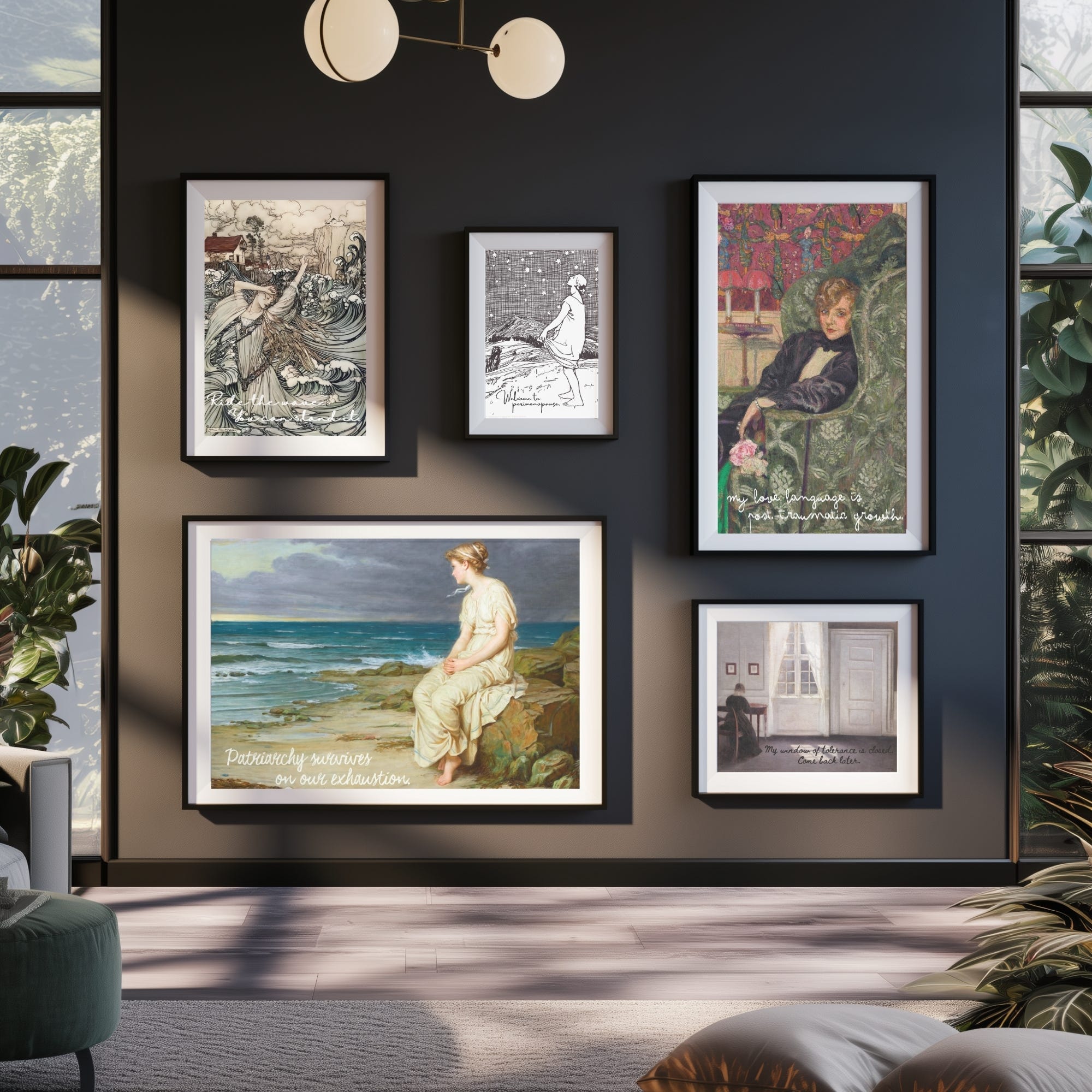
Using works from the public domain, I pair classical imagery with modern observations about mental health, recovery, caregiving, resilience, and the realities of everyday life.

My Window of Tolerance Is Closed. Come Back Later.
Inspired by Vilhelm Hammershøi’s Interior with Young Woman Seen from the Back (c. 1903), this piece reimagines a classical masterpiece with a modern, boundary-setting twist. It serves as a reminder that nobody owes the world their constant attention, accessibility, or emotional availability.
In a culture that often celebrates overextension, this piece makes the case for self-preservation. Sometimes the healthiest thing you can do is recognize that you’ve reached your limit and step away until your capacity returns.

My Love Language Is Post-Traumatic Growth.
The concept of love languages may or may not hold up to serious scrutiny, but post-traumatic growth certainly does.
Adapted from a public-domain work by Édouard Vuillard, this piece takes the language of self-help and reclaims it for something more substantial: the profound process of psychological evolution. Surrounded by Vuillard’s signature sea of colors and patterns, the subject seems to meet the viewer with a knowing look that cuts directly to the point.
There is a quiet intimacy in the image—not the intimacy of romance, but the intimacy of recognition. The kind that develops when you’ve lived through enough challenges to understand that healing changes you. The piece asks us to consider whether our greatest gift to ourselves and others is not our suffering, but the growth that emerges from it.

Ride the Wave. You Can Stand It.
Using artwork by Arthur Rackham, this piece offers a simple but powerful truth: you don’t have to conquer every wave. You just have to survive the one you’re in.
Whether you’re navigating grief, burnout, recovery, uncertainty, or simply the weight of daily life, resilience often looks less like victory and more like endurance. This artwork serves as a reminder that difficult moments are temporary, even when they feel overwhelming, and that sometimes standing is enough.

Patriarchy Survives on Our Exhaustion.
This reinterpretation of John William Waterhouse’s Miranda—The Tempest reframes the central figure not as someone waiting to be rescued, but as someone who has finally noticed just how much labor is required to keep an unsustainable system running.
After all, if even the beautiful blonde woman staring dramatically into the distance is thinking, “This system is unsustainable,” perhaps we should pay attention.
Beneath the humor is a serious observation: exhaustion is not always an accident. Many social systems depend on people being so busy caregiving, managing emotions, meeting expectations, performing unpaid labor, and keeping everything functioning that they never have the time or energy to question the system itself. The piece is a reminder that reclaiming rest is sometimes more than self-care—it can be an act of resistance.

This piece may be my favorite reinterpretation of all.
Using Otto Ubbelohde’s illustration for the Grimm Brothers’ The Star Money (Die Sterntaler), I offer an alternative reading of a beloved fairy tale. The Grimm brothers apparently believed this young woman was standing outside in her nightgown catching magical star coins falling from the sky.
But let’s be honest: she’s clearly having a hot flash.
Viewed through a modern lens, the scene suddenly becomes hilariously familiar. Unfortunately.
Explore the Reframing Art collection: marshpress.etsy.com
On the Serial Memoir: Fat & Drunk
Become a paid subscriber to read the next installment of my episodic memoir, Fat & Drunk. The subscription gives you access to all previous episodes:
Start at the beginning: The prologue to Fat & Drunk.
Wrong explores the paralyzing obsession of disordered eating and the deep-seated belief that I am fundamentally wrong. It captures the frantic, secretive compulsion of a binge—chasing a temporary relief that serves as the perfect psychological prelude to my history with alcohol.
The Day I Was Dying details what happened on September 18, 2009. I was alone in my apartment, convinced my body had finally caught up with every bad choice I’d made. It’s a story about obsession and compulsion. And redemption.