

Remapping Resource: Wearable Technology
When our data feedback needs change with our lives...and our nervous systems

I’ve worn wearable technology through very different chapters of my life: Fitbits, two Apple Watches, and now an Oura Ring. What changed across those chapters wasn’t the technology itself, but my relationship to information—what my nervous system could tolerate, what my recovery could safely hold, and what kind of data actually supported living rather than constant self‑monitoring.
When I first used Fitbits, I was deep in my eating disorder. Technically, they were doing exactly what they’re designed to do: tracking movement, steps, activity, and patterns over time. For someone using a fitness tracker as a neutral tool, Fitbits are very good at that job. But my brain quietly reassigned their function. Movement stopped being descriptive and became evaluative. Numbers turned into permission. The Fitbit didn’t tell me how active I’d been—it told me whether I was allowed to eat, rest, or feel okay about myself.
That wasn’t the product’s fault. It was a reminder that tools don’t exist in a vacuum. They amplify the framework your brain is already using. At that point in my life, any device that quantified my body so precisely was always going to become a measure of worth, regardless of its intent.
When Tracking Became Joy—Briefly
My relationship with the Apple Watch was more complex. I’ve owned two. The first lived in the same mental ecosystem as the Fitbits, when activity rings still carried moral weight. Closing rings wasn’t celebratory; it was compulsory. That watch didn’t last long, because I wasn’t ready to use it safely.
The second Apple Watch arrived later, when something had shifted. I was further along in recovery and able to interact with activity tracking without turning it into punishment. That watch coincided with something genuinely joyful: virtual, asynchronous movement challenges through The Conqueror Challenge. For the first time in my life, movement wasn’t about earning food or offsetting guilt—it earned me medals and ribbons. I walked. I rode my tricycle. I completed challenges. Movement became playful and self‑directed instead of something I had to justify.
I’d originally hoped the Apple Watch would give me complete freedom from my phone. I wanted cellular connectivity so I could leave the house with nothing but a key and walk for miles untethered. That part never quite worked out. I ended up with the wireless versions and brought my phone along anyway. Still, for a while, the watch felt supportive rather than intrusive.
When Connectivity Became Too Much
Then caregiving reshaped everything.
During the pandemic, my parents moved into assisted living. My mother’s medical conditions escalated. My dad was diagnosed with vascular dementia. Messages multiplied. Alerts stacked. Calls came at all hours. The Apple Watch didn’t just notify me—it lived on my body. When my mother was taken to the emergency department in the middle of the night, the phone ringing didn’t wake me. The vibration on my wrist did.
The watch was doing exactly what it was designed to do. And my nervous system absorbed the cost.
After my mother died, the Apple Watch stopped feeling neutral. It became a PTSD object—an embodied reminder of years when being reachable at all times was necessary and survival‑based. The constant connectivity I’d once wanted had become a form of nervous‑system torture.
And yet, the story doesn’t end there.
Because I no longer wanted to wear it, I gave my still‑functional Apple Watch to Dan. It was the heart‑monitoring features of that watch that detected irregularities and led to further evaluation—ultimately resulting in his triple bypass being done without emergency, without catastrophic damage, and without the additional trauma that so often precedes open‑heart surgery.
Both things are true. The same technology that overwhelmed my nervous system helped save his life.
Choosing Quiet Instead
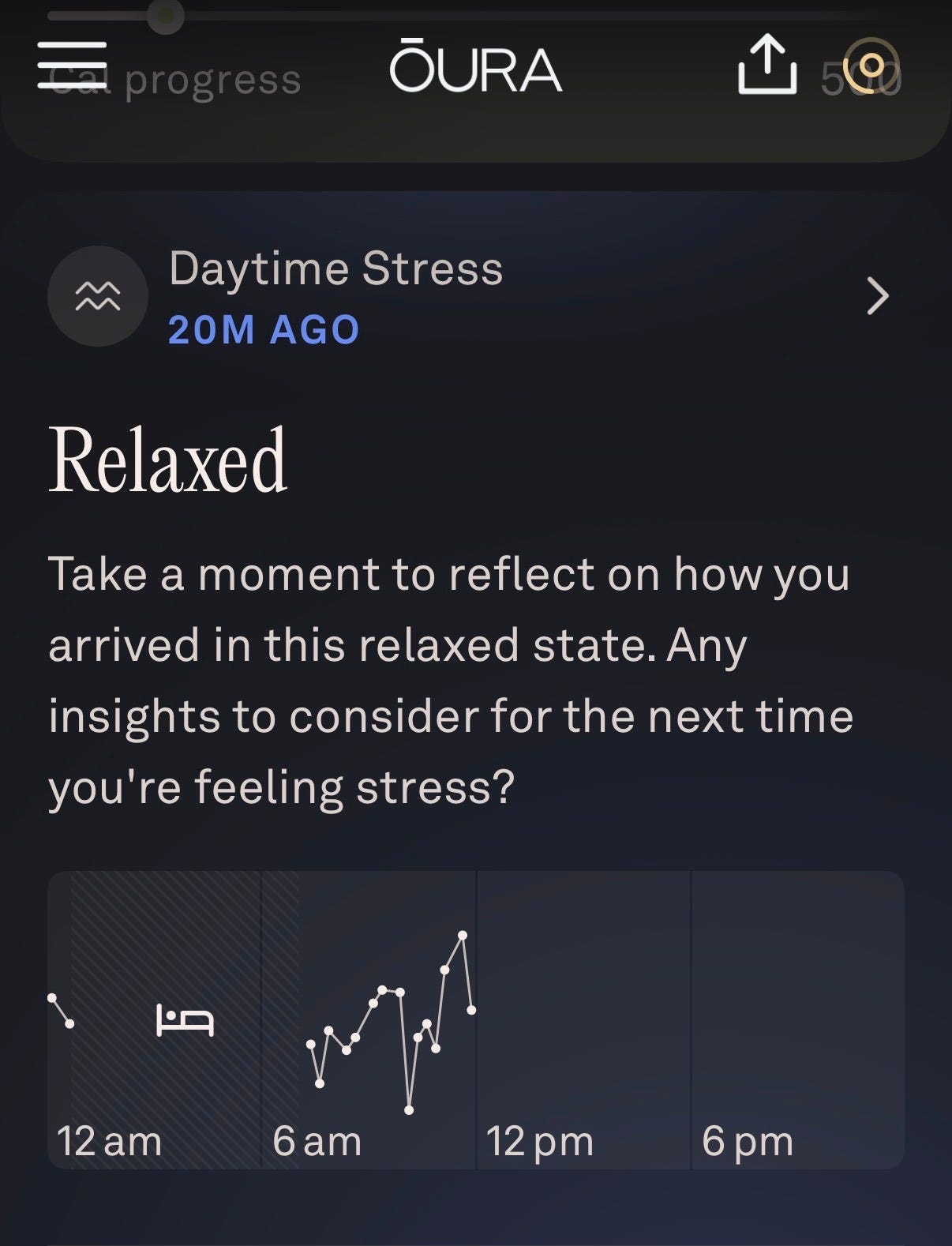
After my mother died, I knew I couldn’t keep wearing something that functioned like a small computer strapped to my body. I still wanted information—but I needed it to arrive quietly, without interruption. That’s when I started learning about Oura Rings. My friend Rachel had one and spoke about it with a steadiness I trusted. When I looked more closely, the distinction became clear: the Oura Ring isn’t designed to demand attention. It’s a receiver.
It collects biological information continuously, but you choose when—and whether—you engage with it on your phone. There’s no buzzing, no tapping, no constant call to respond. Because it’s so contained in what it needs to do, it also goes several days without needing to be charged—typically around four to seven days depending on use. That alone changes the relationship. Charging becomes occasional maintenance, not a daily reminder that something is attached to you.
The data itself feels more holistic and less siloed. Sleep, recovery, readiness, long‑term trends—signals about the whole system rather than metrics to optimize individual behaviors. It’s also far less triggering for eating disorder recovery. The information is broader, less granular, and harder to weaponize against myself.
I did experiment briefly with the food‑tracking feature. At first, I appreciated how it framed nutrition. But I quickly realized I didn’t want commentary on what I was eating. I didn’t need to read that a CLIF Builder Bar was a sugar bomb when the alternative that day would have been a sausage McMuffin. That kind of feedback didn’t help me make better choices—it just introduced judgment where I didn’t need it. So I turned that feature off. Knowing what to ignore is part of remapping, too.
What I’ve kept is what supports me now. The ring alerts me when my body may be getting sick. It nudges me to rest when my system is strained. And when I don’t want to look at the data at all, I don’t have to. My nervous system is noticeably calmer for it.
The Question Beneath the Tech
The real question with wearable technology isn’t which device is best. It’s what kind of information you can receive without turning it into harm. The answer changes over time. Recovery changes it. Caregiving changes it. Grief changes it. The same tool can be supportive in one chapter and destabilizing in another.
For where I am now: Fitbits are excellent for people who want traditional fitness tracking and can engage with metrics without attaching moral weight to them. Apple Watches are powerful and genuinely helpful for activity tracking and health alerts—but they can be overwhelming when your nervous system is already living on high alert. And the Oura Ring fits this season of my life because it gives me insight without intrusion.
This isn’t a ranking. It’s a record—of what worked when, and why.
Notes
Items Reviewed
Peripherals & Add‑Ons I Recommend
More comfortable than silicone
Better for long wear and sensitive skin
I kept several colors and rotated them
Bedside charger that includes a watch charger
One charger for phone + watch
I no longer use the watch, but Dan uses the setup on his side of the bed
Oura sizing is exact; standard ring sizes won’t work
Sizer kits often arrive next day
If purchased from Amazon, the cost is credited toward the ring
Protects the ring from scratches and wear
Especially helpful if you use your hands a lot
Because I cover mine, I chose the least expensive ring color (black)
Travel charger (newer accessory)
Cordless, compact design
Lets you leave the main charger at home
One of the most elegant accessories I’ve used
Cost & Memberships
I’m including cost information for context, not comparison shopping.
Fitbit devices generally range from roughly $100–$300, and while Fitbit offers a Premium subscription (about $10/month or $80/year) that adds deeper insights, guided programs, and expanded health metrics, I chose not to use or pay for any premium features and used the device with its standard functionality only.
Apple Watches typically range from about $250–$800+ depending on model and configuration. Apple offers optional services (such as Apple Fitness+) and cellular plans through carriers, but I did not pay for any add‑on programs or subscriptions related to my Apple Watches; I used the watches with their core features alone. The
Oura Ring differs from both. The ring itself typically costs around $300–$450, and an ongoing Oura membership (about $6/month) is required to access most of the meaningful insights, including detailed sleep analysis, readiness scores, long‑term trends, and health signals. In my experience, the membership is essential—I find it worth the cost, and I don’t think I would have or use an Oura Ring without it.
Disclosure
This article includes tools and accessories I personally used in real‑life contexts. Some links are affiliate links, meaning I will earn a small commission at no additional cost to you. I only include items that were relevant to the situation described and share both benefits and limitations.